Estación de clasificación de pelotas Station de tri de balles Ball sorting station
Una celda de clasificación automática para pelotas de ping-pong rojas, verdes y azules. Un robot móvil lleva cada pelota hasta la estación, un sensor identifica su color y un brazo robótico, controlado por un autómata industrial, la coloca donde corresponde.
Une cellule de tri automatique pour balles de ping-pong rouges, vertes et bleues. Un robot mobile amène chaque balle jusqu'à la station, un capteur identifie sa couleur et un bras robotisé piloté par un automate industriel la range au bon endroit.
An automated sorting cell for red, green and blue ping-pong balls. A mobile robot brings each ball to the station, a sensor identifies its colour, and a robotic arm driven by an industrial PLC puts it where it belongs.
- AñoAnnéeYear
- 2025–2026
- ContextoCadreContext
- Proyecto E&R en equipo, BUT GEII, IUT de CachanProjet E&R en équipe, BUT GEII, IUT de CachanE&R team project, BUT GEII, IUT de Cachan
- HerramientasOutilsTools
- ESP32, PlatformIO, WAGO CC100, Dynamixel, KiCad, SolidWorks, QElectroTech
Cómo funcionaFonctionnementHow it works
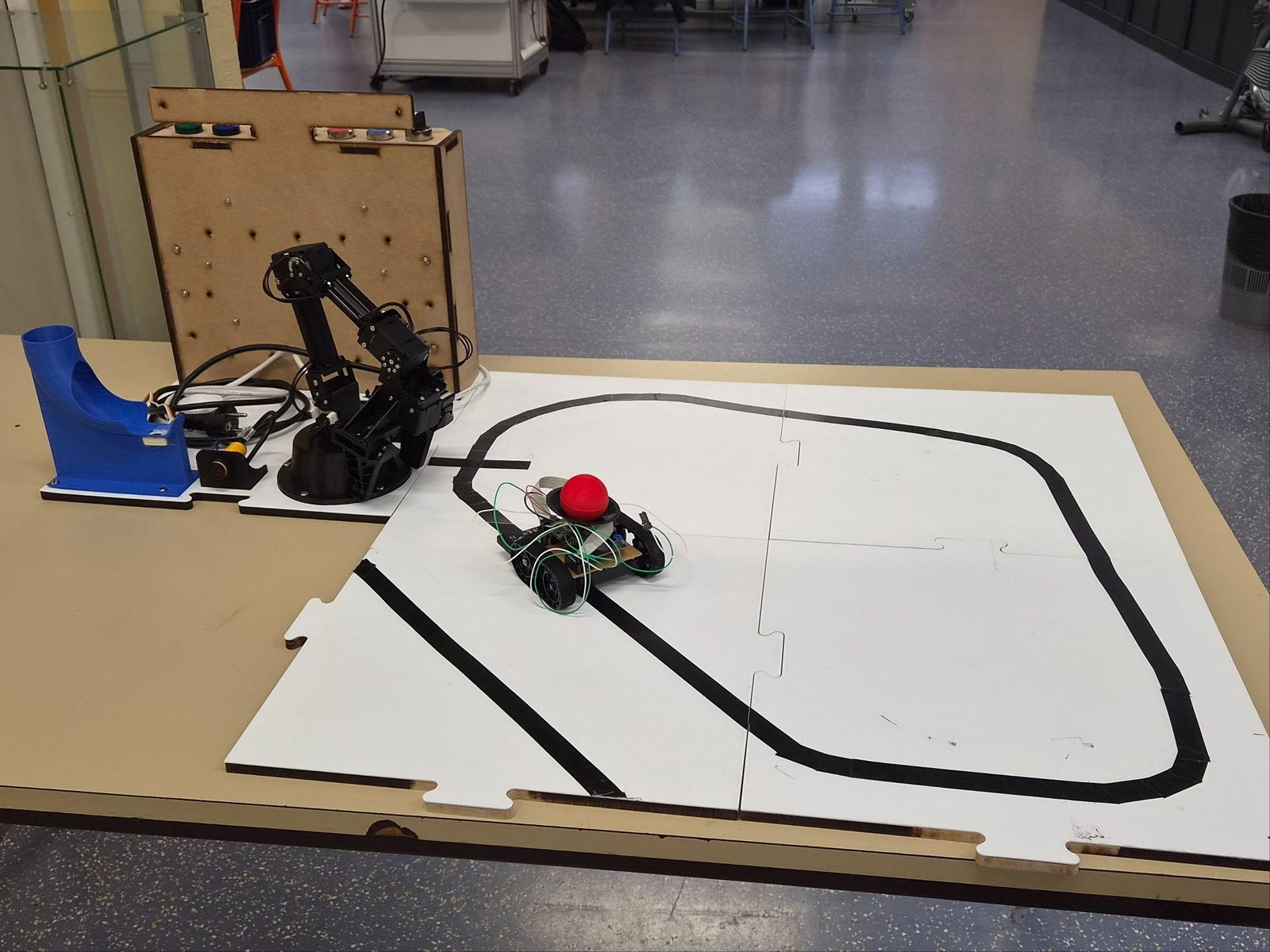
El sistema se divide en tres partes: el robot Zumo, la detección de color y el brazo con su armario de control. El robot recibe una pelota en un embudo y sigue una línea negra hasta la estación. Ahí se lee el color de la pelota, el autómata recibe el resultado y mueve el brazo para clasificarla.
Le système se divise en trois parties : le robot Zumo, la détection de couleur et le bras avec son armoire de commande. Le robot reçoit une balle dans un entonnoir et suit une ligne noire jusqu'à la station. La couleur de la balle y est lue, l'automate reçoit le résultat et déplace le bras pour la trier.
The system has three parts: the Zumo robot, colour detection, and the arm with its control cabinet. The robot catches a ball in a funnel and follows a black line to the station. There the ball's colour is read, the PLC gets the result and moves the arm to sort it.
El robot ZumoLe robot ZumoThe Zumo robot
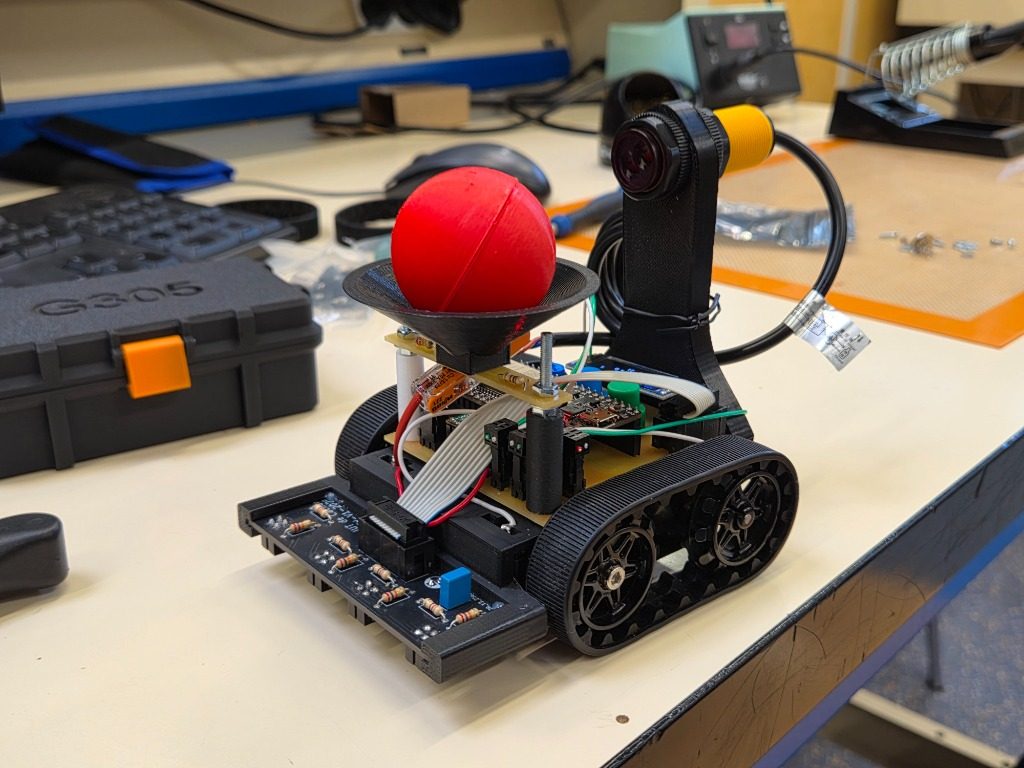
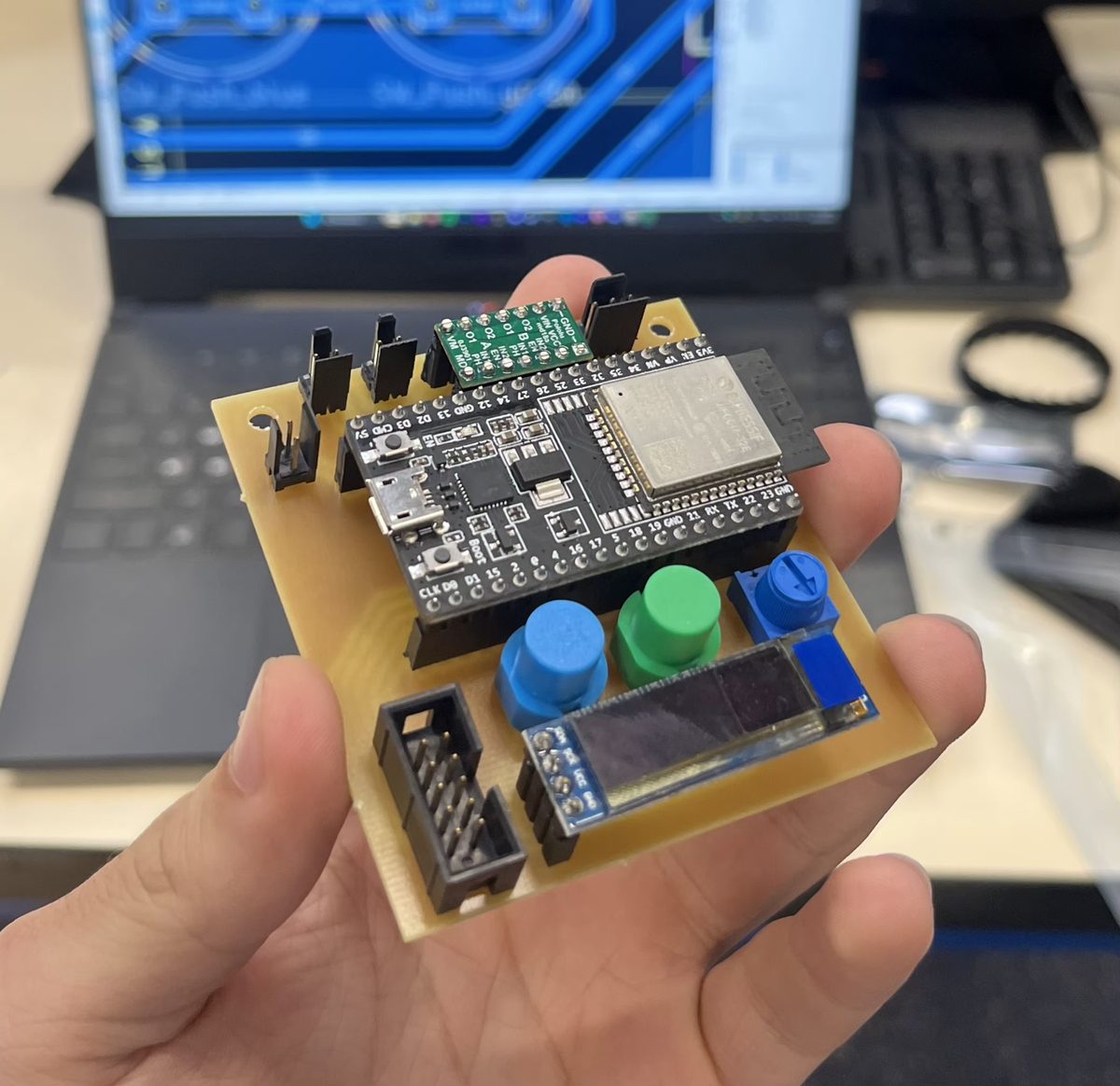
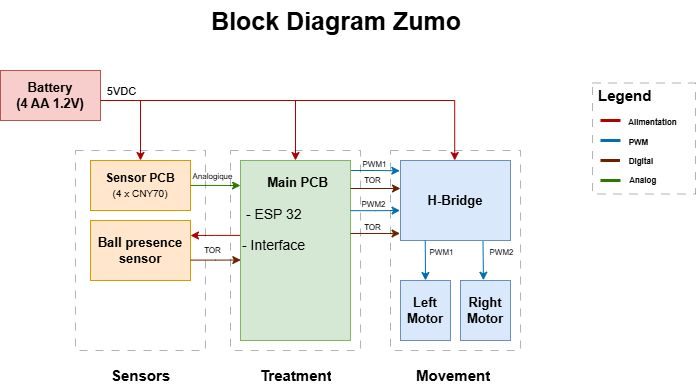
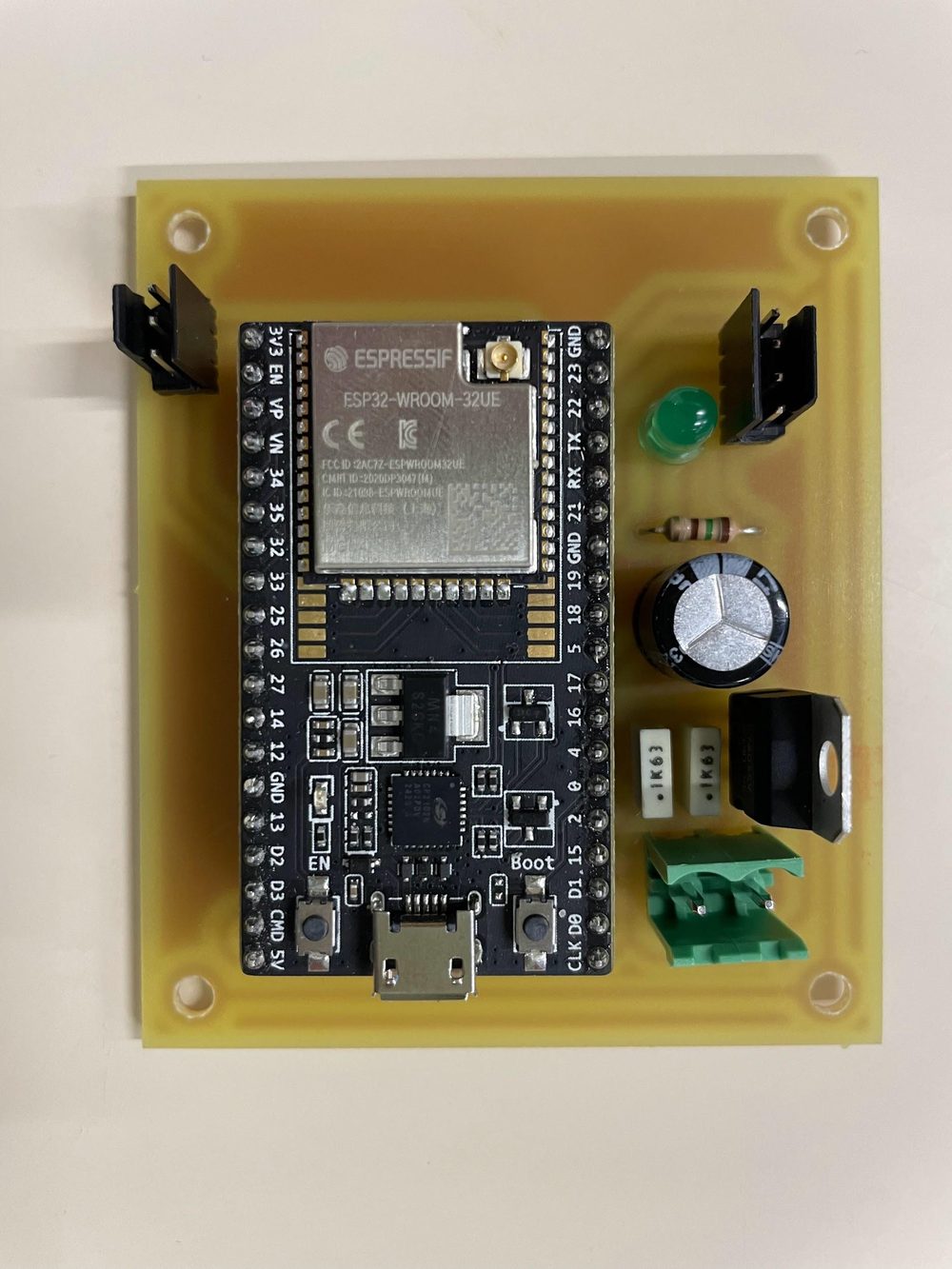
La base es un chasis de orugas Zumo proporcionado por el IUT, con dos motores de corriente continua controlados por un puente H. Encima va una placa diseñada en KiCad alrededor de un ESP32, con un regulador 7805, botones, un potenciómetro y conectores Omnimate.
La base est un châssis à chenilles Zumo fourni par l'IUT, avec deux moteurs à courant continu commandés par un pont en H. Dessus se trouve une carte conçue sous KiCad autour d'un ESP32, avec un régulateur 7805, des boutons, un potentiomètre et des connecteurs Omnimate.
The base is a Zumo tracked chassis supplied by the IUT, with two DC motors driven by an H-bridge. On top sits a board designed in KiCad around an ESP32, with a 7805 regulator, push buttons, a potentiometer and Omnimate connectors.
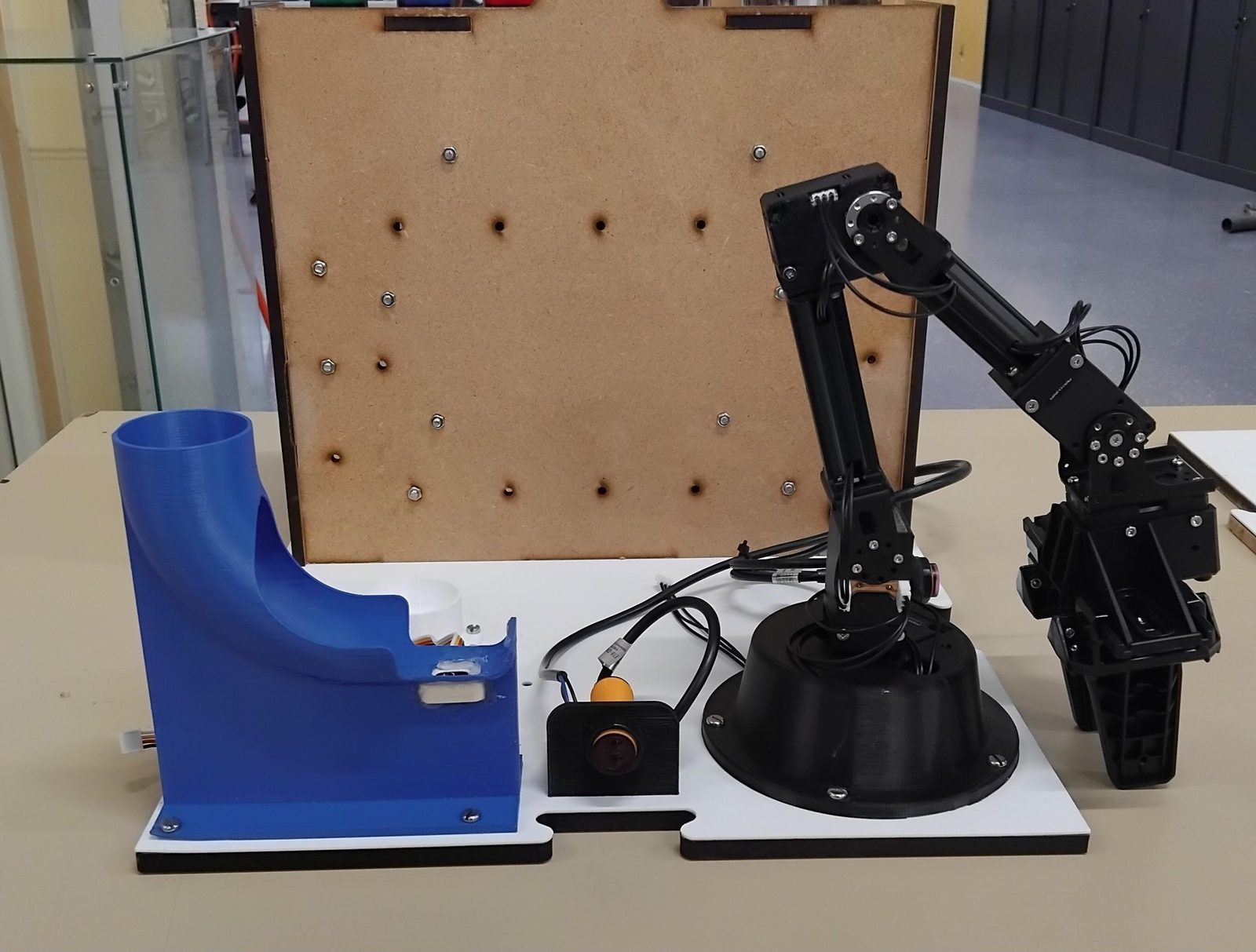
El programa, en C++ con PlatformIO, sigue la línea con cuatro sensores infrarrojos CNY70 y regula la velocidad de los motores por PWM. El embudo que recibe la pelota lo diseñamos en SolidWorks y lo imprimimos en 3D; lleva un sensor óptico que detecta si hay una pelota dentro.
Le programme, en C++ sous PlatformIO, suit la ligne avec quatre capteurs infrarouges CNY70 et règle la vitesse des moteurs en PWM. L'entonnoir qui reçoit la balle a été conçu sous SolidWorks et imprimé en 3D ; un capteur optique détecte la présence d'une balle.
The program, written in C++ with PlatformIO, follows the line using four CNY70 infrared sensors and controls motor speed with PWM. The funnel that catches the ball was designed in SolidWorks and 3D printed; an optical sensor detects whether a ball is inside.
Detección de colorDétection de couleurColour detection
El color lo mide un sensor U009 conectado por I2C a un segundo ESP32, montado en otra placa hecha en KiCad. Este ESP32 traduce la lectura a dos salidas lógicas que van directamente a las entradas del autómata WAGO:
La couleur est mesurée par un capteur U009 relié en I2C à un second ESP32, monté sur une autre carte réalisée sous KiCad. Cet ESP32 traduit la mesure en deux sorties logiques câblées directement sur les entrées de l'automate WAGO :
Colour is measured by a U009 sensor connected over I2C to a second ESP32, mounted on another KiCad board. This ESP32 turns the reading into two logic outputs wired straight into the WAGO PLC's inputs:
| PelotaBalleBall | CódigoCodeCode |
|---|---|
| NingunaAucuneNone | 00 |
| VerdeVerteGreen | 10 |
| AzulBleueBlue | 01 |
| RojaRougeRed | 11 |
Así el autómata no necesita hablar I2C: solo lee dos entradas digitales.
L'automate n'a donc pas besoin de gérer l'I2C : il lit simplement deux entrées TOR.
That way the PLC doesn't need to speak I2C at all: it just reads two digital inputs.
Brazo y armario de controlBras et armoire de commandeArm and control cabinet
El brazo usa tres servomotores Dynamixel: uno gira la base, otro levanta el brazo y el tercero abre y cierra la pinza. Se comunican por bus serie a través de un adaptador RS485–TTL.
Le bras utilise trois servomoteurs Dynamixel : un pour la rotation de la base, un pour l'élévation et un pour l'ouverture et la fermeture de la pince. Ils communiquent par liaison série via un adaptateur RS485–TTL.
The arm uses three Dynamixel servos: one rotates the base, one lifts the arm and the third opens and closes the gripper. They talk over a serial bus through an RS485–TTL adapter.
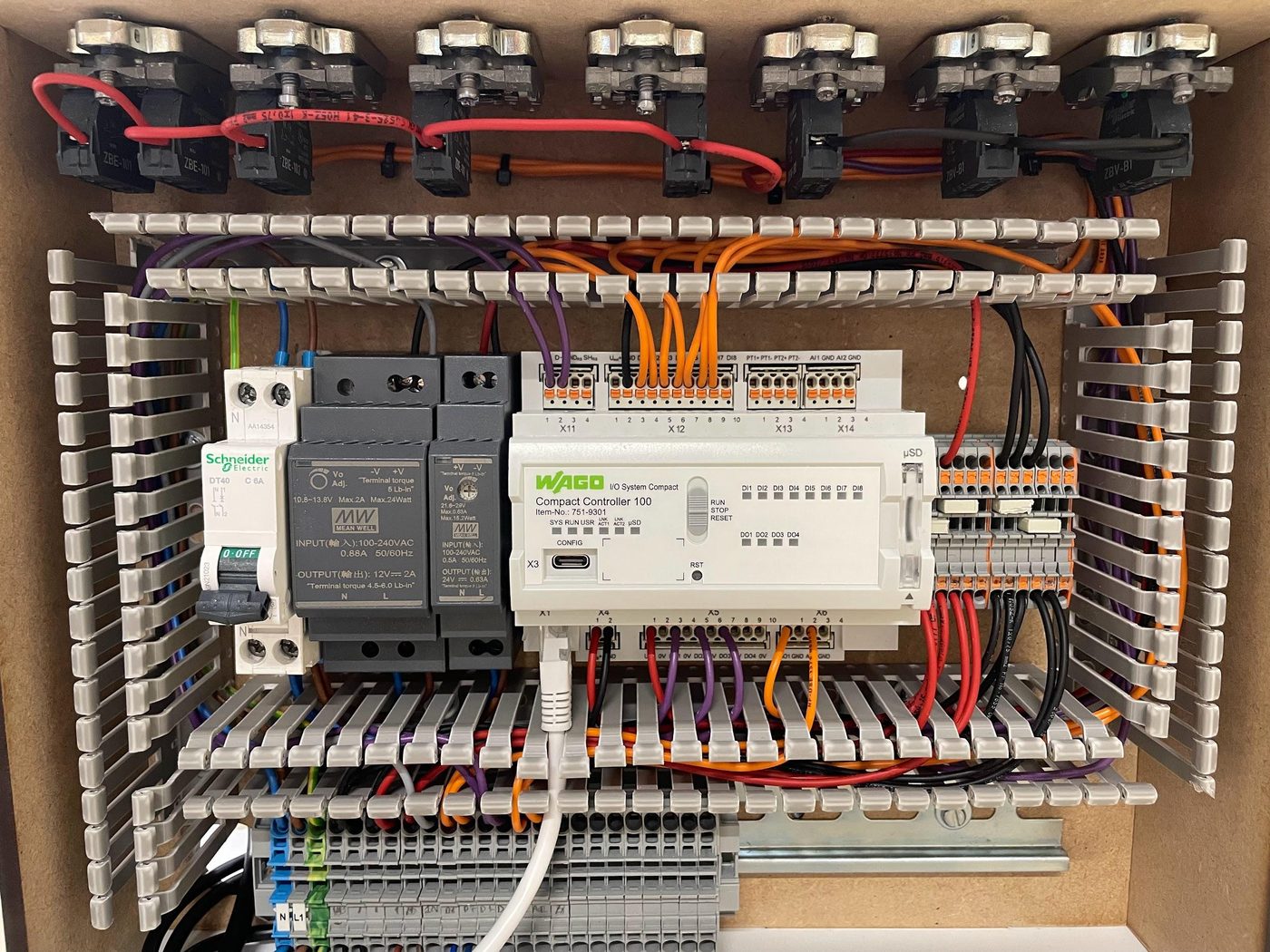
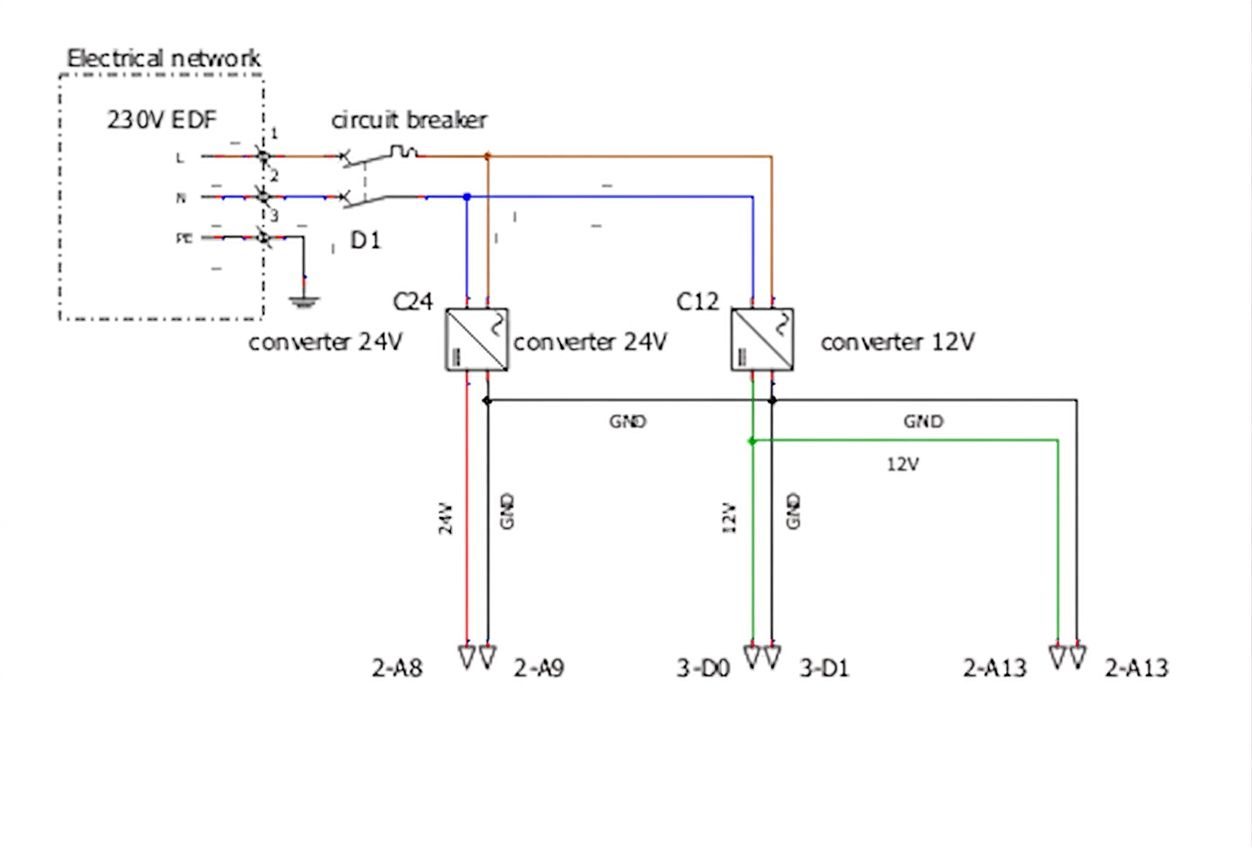
El autómata WAGO CC100 coordina toda la estación. El armario lleva un disyuntor Schneider, fuentes Mean Well de 24 V, 12 V y 5 V, y un panel de mando. Los esquemas de cableado los hicimos en QElectroTech.
L'automate WAGO CC100 coordonne toute la station. L'armoire contient un disjoncteur Schneider, des alimentations Mean Well 24 V, 12 V et 5 V, et un pupitre de commande. Les schémas de câblage ont été réalisés sous QElectroTech.
The WAGO CC100 PLC coordinates the whole station. The cabinet holds a Schneider circuit breaker, Mean Well 24 V, 12 V and 5 V power supplies, and a control panel. The wiring diagrams were drawn in QElectroTech.